Are you sure you want to perform this action?
Updates
2027-2029 EU political reshuffle: the race is on
Executive Summary
EU politics is entering a delicate period. The mid-term reshuffle of posts in the European Parliament coincides with a wave of national elections in the largest Member States, starting in Spain on 29 November 2026 and continuing in France, Italy and Poland in 2027, while the polls are rather negative for the parties that support the von der Leyen Commission. The question now is how big these shifts will be and what kind of majorities and policy changes they will lead to. Current trends indicate that they could be significant.
Last week internal tensions in the EPP surfaced when three of its MEPs tabled an amendment to reject the Industrial Accelerator Act, a flagship Commission proposal, labelling its “Buy European” clauses as detrimental to competitiveness. Could this also mark a turning point in EU policy, towards faster or deeper simplification? What is the balance of power between its proponents and opponents and how will it evolve in the second half of the term?
Simplification is the part of the Commission’s agenda that advances largely with a grand coalition behind it in the Parliament, as the EPP continues to build its majorities with S&D and Renew, while the forces to the right of the EPP are generally pushing for this agenda to go even further. Last week’s plenary session confirmed this.
The national elections due over the next year in Spain, France, Italy and Poland could shift the European Council to the right and leave S&D and Renew without the governments of Spain and France. A weaker S&D is likely to give priority to keeping António Costa as President of the European Council over a challenge for the presidency of the Parliament, while its threat to move into opposition becomes more realistic. Coalitions in the second half of this term are therefore likely to be shaped more by these national elections than by the reshuffle of posts in the Parliament.
Further ahead, the EPP, S&D and Renew are now projected to fall three seats short of a combined majority in 2029, for the first time in the Parliament’s history. The EPP is still in pole position to win those elections and to have a strong foothold in the Council when the new Commission is set up, but it could have to build majorities in a context in which there will be a stronger force to its right and a weaker one to its left. Currently, the EPP’s national delegations hold differing views on cooperation with the Patriots: the French and, to a certain extent, the Italian and Spanish delegations are more willing to vote alongside the PfE, while the German delegation is keen to avoid this. Notably, the Spanish Partido Popular could soon govern with Vox in Madrid and may challenge the German CDU as the most influential EPP delegation in a couple of years.
These political shifts will make policy developments harder to follow in the months ahead. We have built an integrated tool that tracks and forecasts them from each stakeholder’s perspective, presented in a 4-minute video.
01. Trade tensions put the Commission’s coalition under strain
The Commission enters the second half of its term in a delicate political environment. Ahead of the national elections of 2026–27 the parties that support the Executive are under pressure at home, and the strain is now visible inside the President’s own political family.
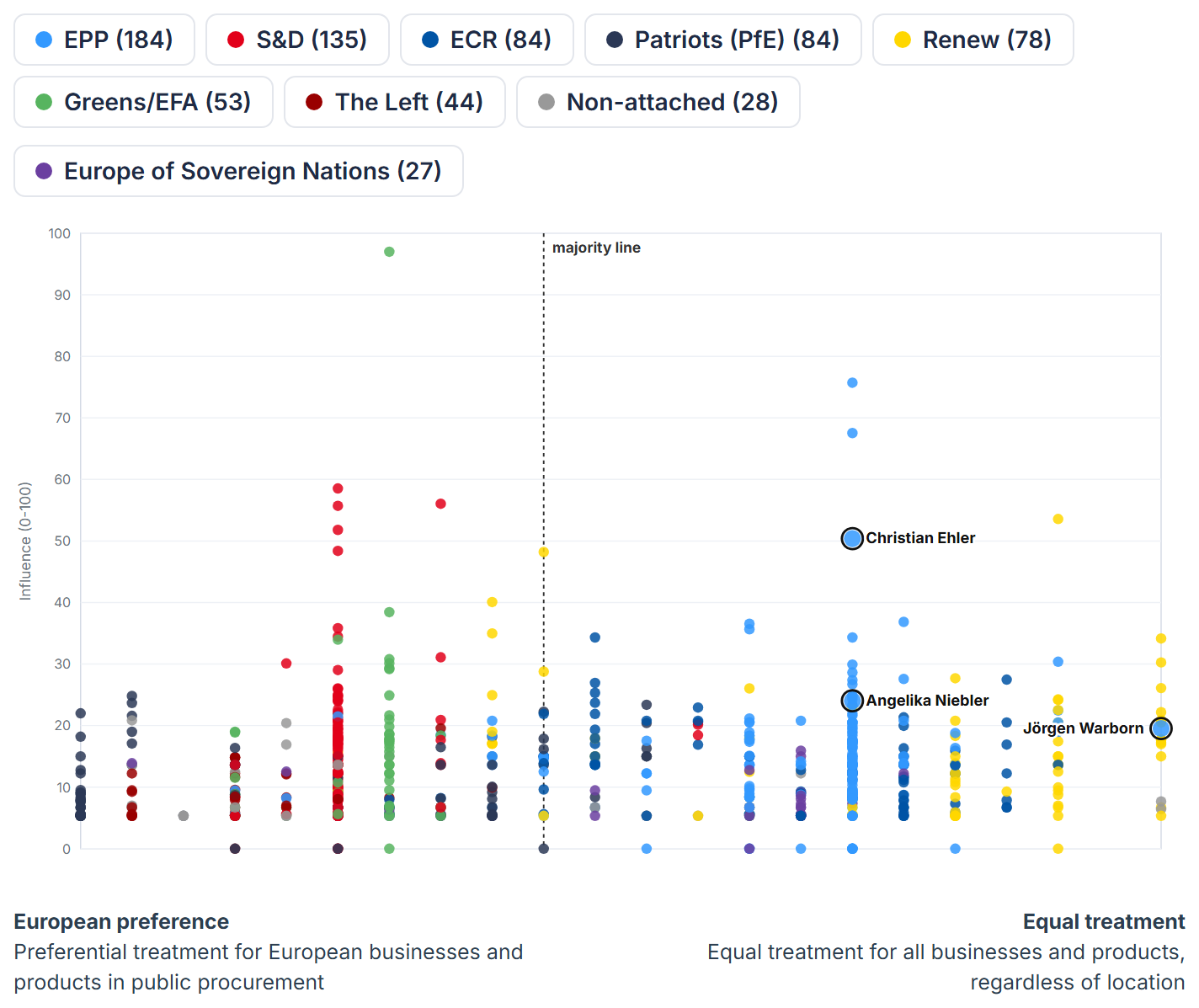
Last week, three EPP MEPs, Christian Ehler, Angelika Niebler and Jörgen Warborn, tabled an amendment to reject the Industrial Accelerator Act (IAA), a flagship Commission proposal. The three MEPs speak for the EPP’s free traders, who doubt that “Buy European” clauses benefit the EU's economy. This reflects the wide range of views in different political quarters over the best path to European competitiveness.
Could the free traders’ proposal reach a majority? We looked into the positioning of each MEP based on a wide range of data (votes, amendments, statements, etc.). Most of Renew, the ECR and the ESN lean towards equal treatment of all businesses regardless of geographical location (Figure 1, where the three MEPs are highlighted). On the other side of this debate we have an (otherwise unusual) combination of "trade-protectionist" forces made up of S&D, the Patriots, the Greens and the Left. As it stands, the EU preference still has a slight advantage over the free traders. However, the IAA also covers decarbonisation and restrictions on foreign direct investment, and objections to these provisions could bring the Patriots into a coalition to reject or considerably dilute the act during compromise negotiations.
Figure 1. Buy European: where every MEP stands
Each dot is one MEP: left to right, their position on the question; bottom to top, their influence on it.
Source: EU Matrix analysis of MEP positions.
The Commission is very active on trade, but is facing political hurdles in both directions, and current trends indicate that this will not get any easier. When the Commission opens markets, as with the Mercosur agreement, it meets substantial opposition from the left and the nationalists. When the Executive favours European producers through “Made in EU” provisions, it is the EPP, von der Leyen's own political family, and other free traders in the EP that put up resistance.
Domestic politics in France and Germany will keep adding to the difficulty. The French and German governments are bargaining to break the trade deadlock on several fronts, including China and the “Made in EU” provisions. Each government faces a rising nationalist party at home, which puts pressure on the governing parties to be more assertive in supporting domestic economic interests. However, the pressure comes from opposite directions: while Rassemblement National pushes for more protectionism, the AfD, at this stage, prefers open markets, which places them on opposite sides of the “Buy European” debate.
02. Grand coalitions remain the rule in the European Parliament
Simplification packages succeed more often than trade-related files because they appeal to broader coalitions. The EPP negotiates compromises with S&D and Renew, sometimes joined by the ECR and the Greens/EFA, which roughly mirrors the von der Leyen coalition.
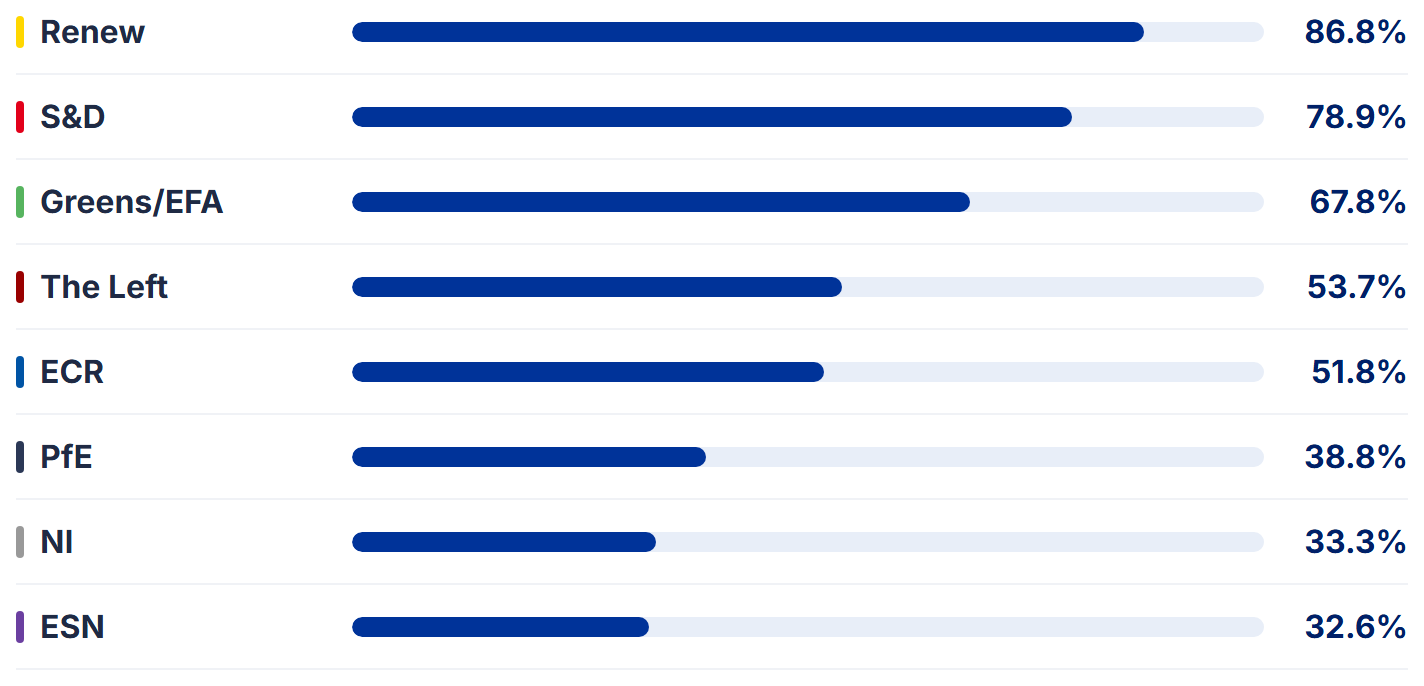
The EPP prefers to stay in the centre on most issues, rather than being associated with the hard right. Grand coalitions therefore still support much of the Parliament’s policy-making: the EPP votes on the same side as Renew on 86.8% of roll-call votes and as S&D on 78.9%. Overall, it votes considerably more often alongside the Greens than it does alongside the ECR and PfE (Figure 2).
Figure 2. EPP coalitions in the EP
Share of roll-call votes on which the EPP and each other group took the same side.
Source: European Parliament, plenary roll-call votes.
Last week's plenary followed the same lines. The INSPIRE simplification and the agreement on CO₂ classes for heavy-duty vehicles passed with the support of the EPP, S&D, Renew and most ECR members, while most of the Patriots voted against. The resolutions on corporate taxation and on mental health at work saw a similar outcome.
The exceptions, while fewer, are politically significant and highly visible. The resolution on Islamism adopted on 8 October is one such example: the EPP, Renew, the ECR and the groups further right secured its adoption by 381 votes to 167, against the opposition of S&D, the Greens/EFA and The Left.
03. The 2027–2029 electoral competition has started
The EPP won the 2024 elections and unambiguously leads the EU institutions, which also means the party will likely be held accountable for policy outcomes in 2029. The EPP is mindful of this and has already started preparing its platform for the next European elections, more than two and a half years away.
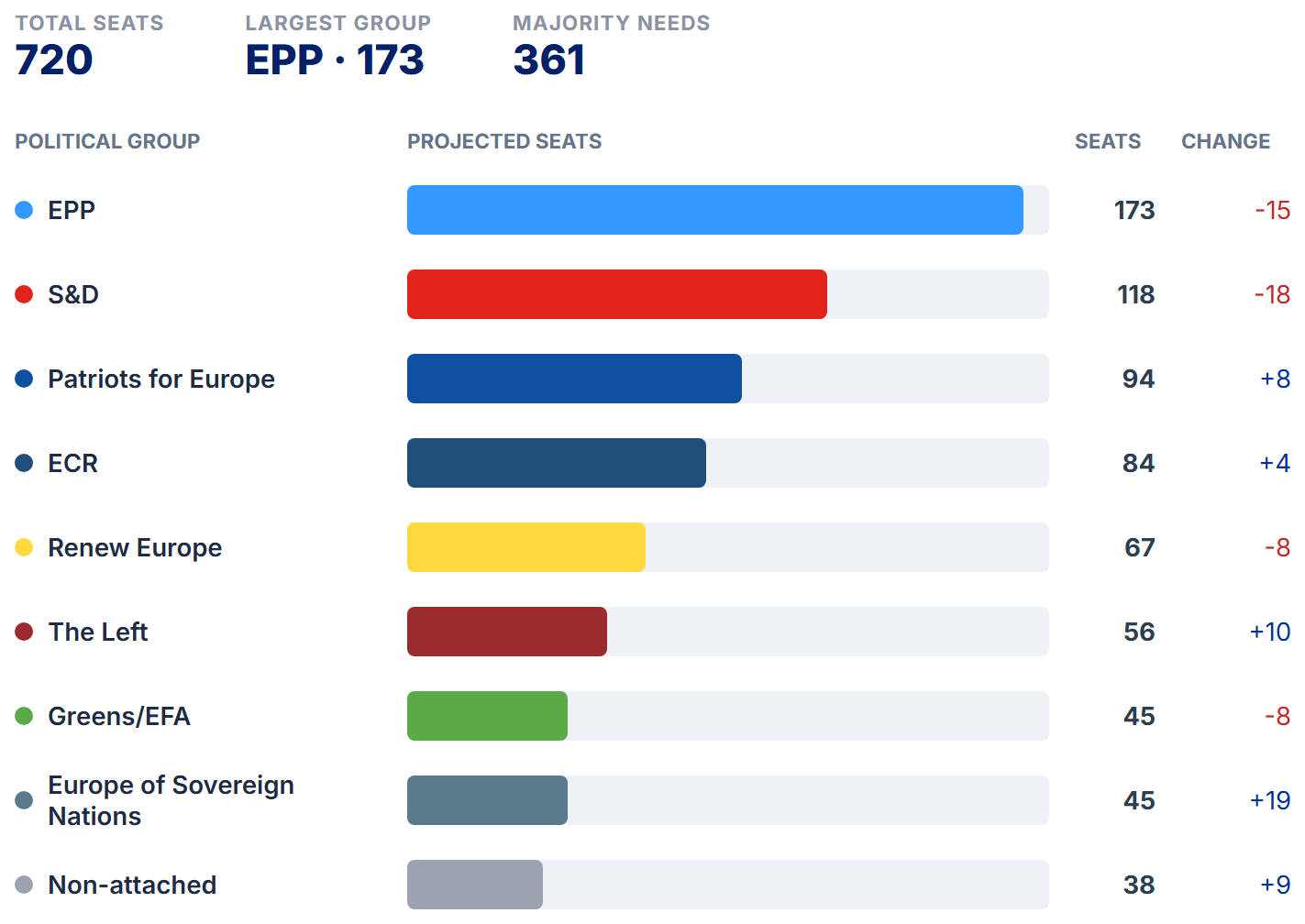
The polls are currently negative for the majority behind the second von der Leyen Commission. According to the latest EU Matrix projections (based on the aggregation and modelling of national surveys), the EPP, S&D and Renew would all lose seats, while the groups at the edges of the Parliament would gain, especially on the right (Figure 3). Together the EPP, S&D and Renew would hold 358 of 720 seats, three short of a majority. Their political families would lose their combined majority for the first time in the Parliament’s history.
Such a result would pull the EPP in two directions. The Greens/EFA are projected to lose seats as well, yet they would become more necessary to sustain a centrist majority, which would increase their importance in coalition-building. At the same time, the EPP would also face greater pressure to work with the ECR and the parties further right, especially if more of these nationalist parties join governments in their own countries.
Figure 3. EP projections 2029
Projected seats, with change vs the current Parliament. Bars are drawn relative to the largest group; a majority needs 361 of 720 seats.
Source: national opinion polls from publicly available sources, with seats apportioned by each Member State’s electoral method.
How far the EPP cooperates with the hard right depends on the national delegation and, just as much, on the subject. Over the whole term Les Républicains have voted with the Patriots on about half of the votes that divided the Patriots from S&D, while the Spanish, Polish, Italian and German delegations did so on roughly a quarter (Figure 4). On migration all five move towards the Patriots: two thirds of the votes for the French, and between a third and a half for the others. On economic and regulatory files the Polish delegation votes with the Patriots more often than the Spanish, Italian and German ones. Migration questions made up an unusually large share of the votes in recent months, which is why the EPP has lately appeared closer to the right than it has been over the term.
The Partido Popular carries particular influence, because of its size and its prospect of taking power in Madrid in November. One of its leading members, Esteban González Pons, is likely to lead the EPP's campaign for 2029, when the PP could become as influential as the CDU inside the EPP.
Figure 4. How the EPP splits on polarising votes
Roll-call votes where the Socialists (S&D) and the Patriots (PfE) took opposite sides. For each EPP national delegation: how often its MEPs voted with the Patriots rather than with the Socialists, on all votes, on migration and on economic and regulatory files.
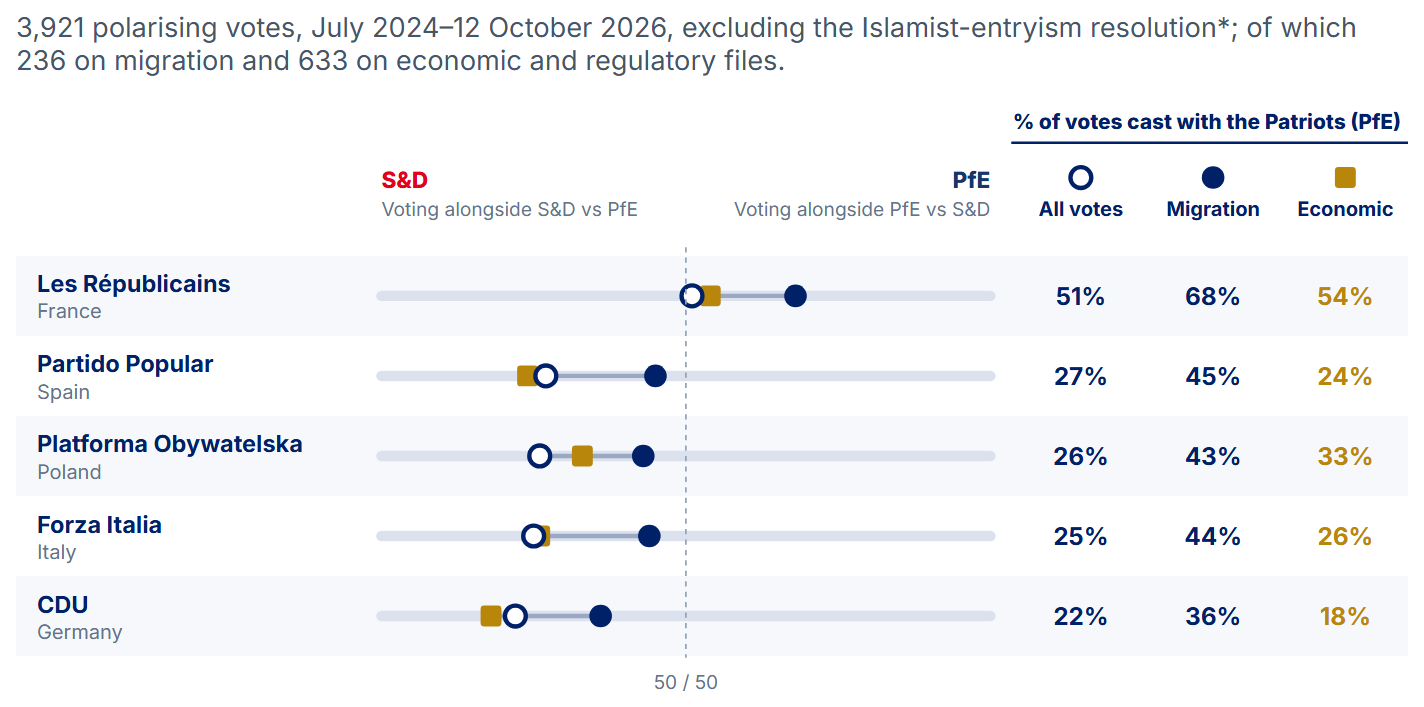
* The resolution on Islamist entryism is not included because its large number of votes would skew the overall statistics. Economic and regulatory files: international trade, agri-food, environment, transport, economy and taxation, energy, industry and internal market. Source: European Parliament, plenary roll-call votes, July 2024–12 October 2026.
04. National elections will put the political support for the Commission to a tough test
Spain votes early, on 29 November 2026. France’s presidential election and parliamentary elections in Italy and Poland follow in 2027, and Romania could join them. Germany is the only one of the largest Member States with no national election due in 2026–27, although its coalition is currently shaky and, given the infighting that has driven Chancellor Merz's approval ratings very low, early political change in Berlin is not unlikely.
Polling points to a possible rightward shift in France and Spain. After losing power in Hungary, PfE parties could enter government in France and, with Vox as junior partner, in Spain. Italy and Poland are closer contests, where right and left blocs are comparable in strength. At this stage, the ECR-led government in Rome and the EPP-led government in Warsaw are in pole position to retain power.
These outcomes would change the European Council considerably. EPP leaders would represent almost half of the EU population in a year’s time, while the Patriots would rise from 2.4% to 17.7%. The combined share of S&D and Renew would fall from about a third of the EU population to just over a tenth (Figure 5).
Figure 5. Possible balance of power in the Council, 2027 (scenario)
Share of the EU population represented by each political family: today and projected in one year, to October 2027.
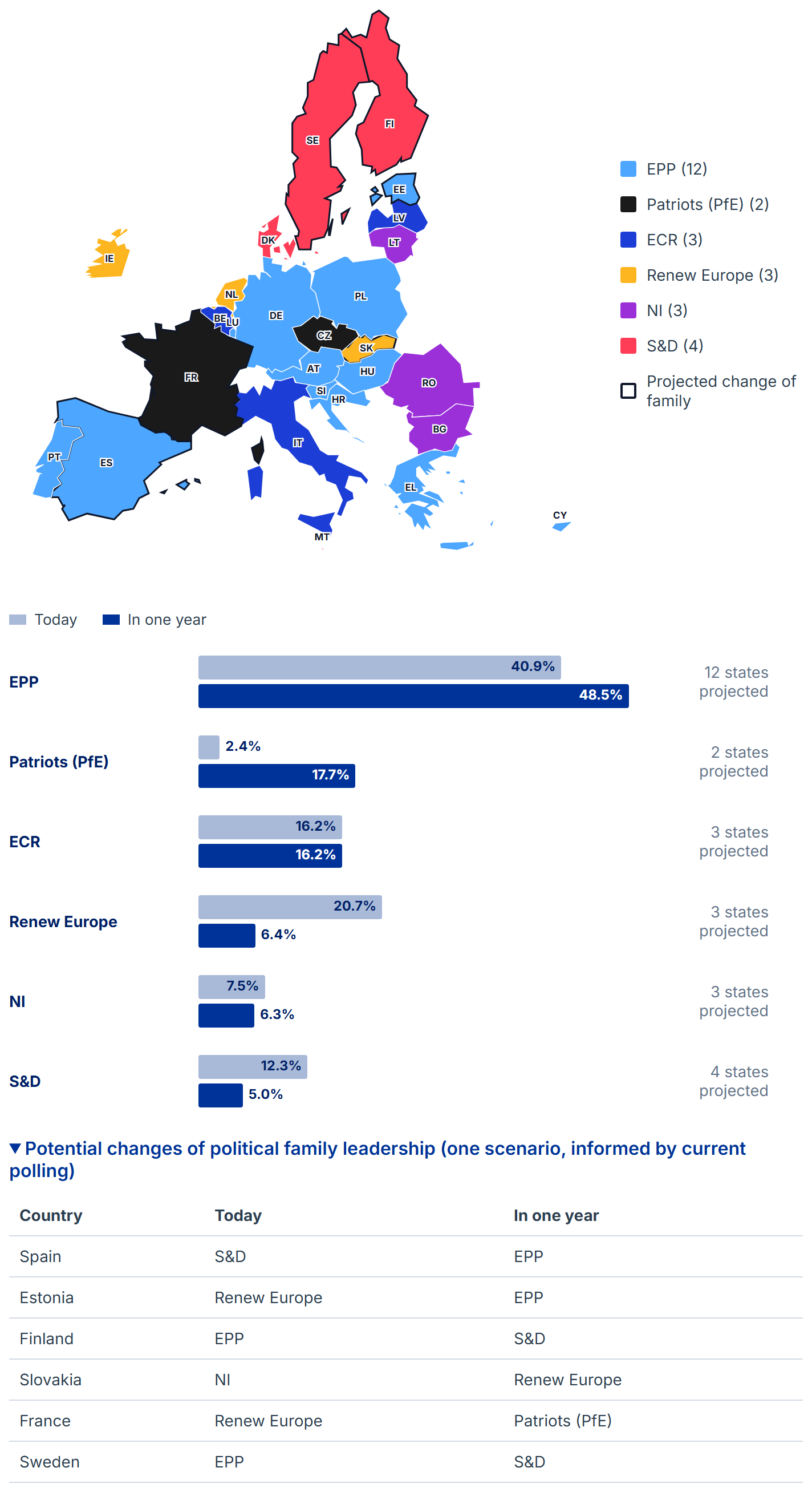
Sources: Eurostat (population, around 2025); European Council membership. The situation in one year is one possible scenario, assessed by EU Matrix analysts on 9 October 2026 in the light of current polling. It is not a forecast: several of these contests, including the French presidential election, remain open.
S&D and Renew would lose more than weight in the European Council: the national parties of both group leaders, in Spain and in France, would be in opposition. With Spain’s election brought forward, the weaker prospects of S&D in both institutions narrow its room for manoeuvre in the mid-term reshuffle. S&D is likely to make keeping António Costa as President of the European Council its priority, rather than mount a challenge for the presidency of the European Parliament. The EPP is seeking to retain that post through an unusual third term for President Metsola.
For now, S&D is hoping for concessions from the EPP on policy, coalition-building and committee-level positions. In the longer run, S&D is considering taking a public "opposition stance" as 2029 approaches, to make itself competitive on the electoral "market". We can therefore expect S&D to become increasingly critical of the EPP, and possibly less willing to build legislative compromises with it, as it tries to present itself as the credible opposition.
Stakeholder Augmented Intelligence: a 4-minute presentation
In this volatile political environment, policy developments will become increasingly difficult to follow. This is why we have built an integrated tool that tracks and forecasts them, analyses every piece of information from each stakeholder’s perspective, and tells you what you need to know, what you can do and whom to engage to consolidate your position.
Watch the presentation of our new stakeholder intelligence dashboard. Be the most informed in the room. Engage with confidence.

Enter your professional email address and you will receive a secure access code.
Related posts
Categories