Are you sure you want to perform this action?
Updates
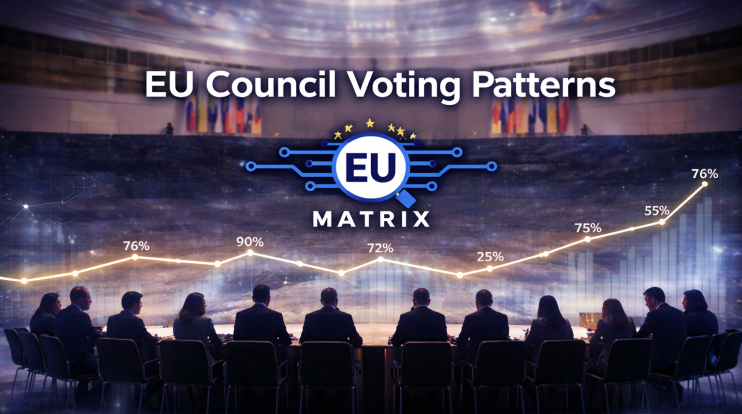
EU Council: Voting Patterns (March 2026)
Analysis of Council voting data from 2009 to 2025.
According to the latest EUmatrix analysis, Council voting patterns point to a trend of fewer unanimous decisions in Brussels. While part of the pre-2020 divergence was driven by the United Kingdom ahead of the Brexit referendum, unanimity levels have remained structurally lower even after its exit. Consensus was temporarily restored during "crisis politics" — notably Covid-19 and the early phase of the war in Ukraine — but as the EU has returned to "normal politics", legislative files increasingly expose underlying political and economic divergences among Member States. The parallel rise in minority positions further illustrates this trend, with a relatively small group of governments accounting for a disproportionate share of dissent in Council negotiations.
Unanimous Votes
Most in Minority (2020s)
EU Council: Unanimous Votes
Percentage of unanimous decisions by year (2009–2025)
Hungary clearly stands out as the main outlier — both at ministerial and European Council level. This position explains why, despite being a medium-sized Member State, its elections attract disproportionate attention in Brussels: Hungary sits at the centre of many vetoes or minority coalitions, meaning its domestic political direction has immediate EU-level consequences.
As the Hungarian electoral cycle approaches, this pattern is likely to intensify, in a context where contesting "Brussels" can generate domestic political returns. A renewed mandate for the current government would likely reinforce its position, particularly on sovereignty-sensitive files such as migration, budgetary conditionality and climate policy — areas where Hungary most frequently deviates — thereby complicating coalition-building ahead of key dossiers including the next MFF, the Return Directive and other major industrial packages. At the same time, such an outcome would further strengthen the emerging "sovereignty axis" within the Council with Slovakia and the Czech Republic. That said, the reverse also holds: given Hungary's outsized role in minority coalitions, even a modest recalibration in Budapest could meaningfully shift the balance of Council consensus.
At EUmatrix, we systematically extract, structure, and analyse positions expressed by government representatives in Council sessions, as well as in the media and social media. We also closely track national electoral dynamics and their impact on governments' positioning in Brussels. This enables stakeholders to anticipate fractures, calculate shifting majorities, and adapt their strategies with precision.
* For tailored analyses or subscriptions to our real-time monitoring platform, contact [email protected]
Related posts
Categories